How to Teach Kids Responsibility and Independence (Without Nagging)
By Ernesto Franco · Updated September 2026 · 8 min read
Why doesn't my child take responsibility for anything?
Usually because they don't have to. If a parent is the reminder system, the child's job is to wait for the reminder — and they get very good at it. This isn't laziness. It's a rational response to how the household actually works.
There's a developmental piece too. Holding a sequence of steps in mind, starting a task without a prompt, and checking your own work are executive functions, and they mature slowly into the late teens. A six-year-old genuinely cannot hold a five-step routine in working memory while distracted. Asking them to is asking for a skill they don't have yet.
Both facts point the same direction: stop supplying the memory, and supply a structure instead.
Why is nagging counterproductive?
Every reminder does three things at once:
- It rescues the child from the consequence, so the routine never proves it matters.
- It confirms that the parent is the system, so the child doesn't build their own.
- It turns a neutral task into a conflict between two people.
That third one is why mornings feel like a fight. The moment a parent's voice is the checklist, the child is pushing back against you, not against the task. Move the asking to a chart, a list, or an app, and there's no one left to argue with.
How do I actually transfer responsibility to my child?
The transfer works in a specific order. Skipping steps is why most attempts fall apart after a week.
- Pick one routine, not all of them. The worst recurring moment of your week. Only that one.
- Build the list with your child, not for them. Ask what they need and write down their words. A list a child helped create is a list they'll follow; a list handed to them is one more instruction from a parent.
- Make it visible and specific. "Get ready" is not a routine. "Backpack, water bottle, reading folder, shoes" is. Vague steps require a judgment call, and judgment calls are exactly what the child can't do yet.
- Hand over the checking. The child marks each step done. This is the part that builds ownership — if you do the checking, nothing has actually transferred.
- Go quiet. Hardest step by far. When you feel the "did you remember—" coming, point at the list instead, or say nothing.
- Let one failure happen. Arriving at practice without cleats teaches the value of the system in a way no amount of explaining will. Natural consequences are the lesson; keep them small and don't add a lecture on top.
What age can kids start doing this?
A rough guide, with wide individual variation:
| Age | What they can own |
|---|---|
| 3–5 | Two or three step picture routines; getting dressed; putting shoes away |
| 6–8 | Four to six item text or icon checklists; packing a bag for a known activity |
| 9–11 | Several routines across a week; some lists they design themselves |
| 12+ | Owning their own schedule, with the parent as backstop only |
Children with ADHD or other executive-function differences typically need the same approach with more external structure, and for longer — visual rather than text, shorter lists, and consistency that outlasts your patience. The method doesn't change; the timeline does.
Should I use rewards, or does that backfire?
Rewards are good at starting a habit and poor as a permanent arrangement. A star chart or points system gives a child a reason to engage during the first few weeks, when the routine is still effortful and has no intrinsic payoff. The risk is escalation — where the reward has to keep growing to produce the same behaviour.
The usable version: reward the routine while it's new, let the reward fade as it becomes automatic, and shift your language from "you earned a star" toward "you handled that yourself." You're aiming to make the child's own competence the payoff.
What tools help kids follow routines independently?
Paper or printable routine charts. Free and immediate. Best for a single child with an identical routine every day. Most families find kids stop seeing the chart after a couple of weeks — it becomes wallpaper.
A kitchen whiteboard. More flexible than paper, but a parent has to rewrite it, which quietly keeps the job with the parent.
Visual timers and clocks. Tools like the Time Timer solve a different problem — pace rather than sequence. They pair well with a checklist; they don't replace one.
Chore and allowance apps. Greenlight, BusyKid and similar are built around money and weekly task completion. Strong for chores and earning, oversized if what you need is "leave the house with the right things."
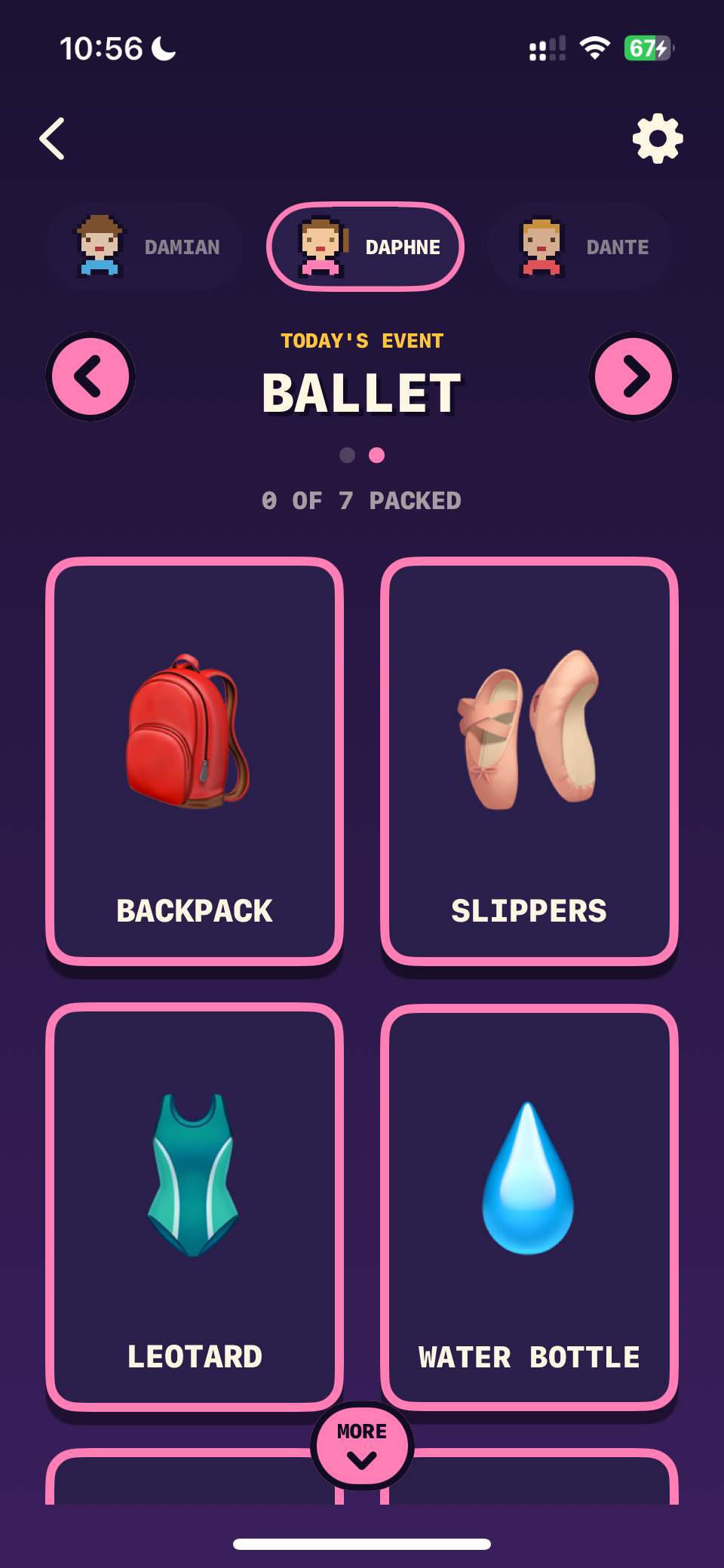
Routine and checklist apps for kids. Purpose-built for repeatable sequences — getting ready, packing, bedtime — with the tapping and the reward loop aimed at the child rather than the parent. Ready Set Remember sits in this category.
What is Ready Set Remember?
Ready Set Remember is a free iPhone app that turns a family's routines into checklists kids run themselves. Each child builds their own pixel avatar and keeps their own routines. Every activity can hold a different one, so swim day and library day are separate lists rather than one long list the child has to filter. Kids tap items off as they pack them, earn stars for finishing, and spend those stars in a rewards shop a grown-up sets up.
It's deliberately narrow: repeatable get-ready-and-go routines. Not chores, not allowance, not screen time.
- A separate routine per activity and per child
- Tap-to-pack checklists sized for young readers, with sound and haptics
- Stars earned on completion, spent in an in-app rewards shop
- Pixel avatars kids build for themselves
- Optional Apple Calendar link, so the right list shows up on the right day
- Free, no ads, iPhone, iOS 16 or later
Which approach fits my family?
| Situation | Best fit |
|---|---|
| One child, identical routine daily | A printable chart on the wall |
| Child struggles with pace, not sequence | A visual timer plus a short list |
| You want chores and money tracked | A chore and allowance app |
| Routines differ by day or activity | A per-routine checklist app |
| Several kids on different schedules | Per-child routines in one app |
| Child won't engage with a list at all | Something with a visible reward loop |
| Teenager | Their own phone calendar — and step back |
Frequently asked questions
How long does it take for a routine to actually stick?
Expect a few weeks where it feels like more work than doing it yourself. That early phase is where most families quit. Consistency during those weeks matters far more than which tool you picked.
My child follows the routine for a while, then stops. What now?
Normal. Usually the list has gone stale or grown too long. Rebuild it with them, cut it back to the essentials, and treat it as a reset rather than a failure.
Does this work if there are two households?
Yes, and it often works better. Make each home's routine its own list rather than one shared one. Consistency of method across households matters more than identical lists.
Won't a checklist just make my kid dependent on a checklist?
Adults use checklists, calendars and reminders their entire working lives. The goal was never a child who needs no supports; it's a child who runs their own supports instead of relying on a parent's voice.
Is an app better than paper?
Not inherently. Paper wins on simplicity and costs nothing. Apps earn their place when routines vary by day or activity, when there's more than one child, or when the reward loop is what gets a reluctant kid to engage at all.
What's a good first routine to hand over?
The one that causes the most friction each week — usually a specific activity with gear, like swim or soccer, rather than the whole school morning. A narrow routine with an obvious consequence teaches fastest.
Ready Set Remember is free on the App Store, for iPhone. Questions or ideas: info@readysetremember.com.
Download on the App Store