Why Is My Kid So Distracted When We're Trying to Leave the House? (And How to Get Out the Door Faster)
By Ernesto Franco · September 2026 · 9 min read
Quick question before the explanations. If your kid forgets their water bottle every single day, what's your honest theory about why?
Mine was that he wasn't paying attention. Or that he was rushing. Or — on the worse mornings — that he didn't really care, because the consequence lands on me and not on him. I'd have told you the fix was obvious, too. Be more consistent. Start earlier. Put a chart on the fridge.
We did all of it. We had a laminated chart with pictures on it. It worked for about two weeks and then it may as well have been part of the wall.
What none of that explained was why it kept getting worse. I was reminding more than I ever had and they were remembering less than they ever had. That's the part worth sitting with, because if the "they're not paying attention" theory were right, more attention from me should have helped. It didn't. So the theory was wrong.
Why does my kid get distracted the second I ask them to get ready?
Because "get ready" isn't one instruction. It's a plan, and building a plan is the expensive part.
When you say "go get ready," an adult brain silently expands that into shoes, jacket, bag, bottle, check the weather, where are the keys. A child's brain has to do that expansion consciously, item by item, while also starting the first step. Psychologists call the gap between hearing a task and beginning it task initiation, and it's one of the last executive functions to mature. It's not a willingness problem. There's a real lag, and filling that lag with a second instruction resets the clock.
This is why the kid who has been asked to get ready is somehow lying on the floor holding a sock. That's not defiance. That's a plan that collapsed halfway through being built.
Is my kid ignoring me, or do they genuinely not see it?
Often, genuinely not seeing it. There's a well-studied effect called inattentional blindness: when attention is occupied, people fail to register objects in plain view — not because their eyes missed them, but because the object never made it into conscious awareness. The famous version is the experiment where viewers counting basketball passes fail to notice someone in a gorilla suit walk through the middle of the shot.
A child crossing the kitchen while holding the abstract goal "get my stuff" is in exactly that state. The bottle is on the counter. Their eyes pass over it. It does not register, because they're searching for a category, not looking at a thing.
If you have kids, you already know this experience from the other side — you point at the object, from four feet away, and they still say "where?" That's the tell. They aren't winding you up. The search image in their head doesn't match the shape on the counter.
Why does it take forty minutes to leave for a ten minute drive?
Because the time isn't going where you think. Almost none of it is spent putting shoes on. It goes into a loop that runs several times:
- You issue an instruction, often from a different room.
- The child starts walking and the instruction decays before they arrive.
- They reach the destination with no active goal and get pulled into whatever is there — a sibling, a toy, a window.
- You notice the silence and reissue the instruction, louder.
- They come back and ask you where the thing is, so the search lands on you anyway.
Every pass through that loop costs three to five minutes. Run it four times and you've lost the morning. The fix isn't to run the loop faster, it's to cut the number of passes, and nearly all of that comes from step two.
One specific thing worth changing today: stop giving instructions from another room. A voice from down the hall creates a goal with no visual anchor attached, which is the most fragile kind. The same sentence said while standing in the room where the object is survives far longer.
Does telling them to hurry up make them faster?
No, and reliably the opposite. Time pressure narrows attention, which is exactly wrong for a task that requires scanning a room. It also adds a second job to the child's plate: managing your mood. A kid who is now monitoring whether dad is angry has less capacity left for remembering the goggles, not more.
There's a version of hurrying that does work, and it's informational rather than emotional. "We're leaving in five minutes" gives them something to plan against. "HURRY UP" gives them something to feel. A visible countdown — a kitchen timer, a clock they can read, one of those coloured timer discs — beats both, because it takes you out of the loop entirely.
How do I get my kids out the door faster?
In rough order of how much time each one actually buys back:
- Stage the night before. Everything that can be packed at 8pm should be packed at 8pm. Bags by the door, shoes underneath them. You are not trying to remember better in the morning, you're trying to have less to remember.
- Give them a list they can see from where they're standing. Not on the fridge in the other room. Where the packing actually happens, at their eye level.
- One item at a time, named and located. "Your blue bottle, on the counter by the sink" defeats inattentional blindness. "Your stuff" feeds it.
- Let them do the finding. The moment you find it, you've taken the job back, and you'll be doing it again tomorrow. Point at the list, not at the object.
- Make the list specific to today's activity. A single master list forces the child to filter, and filtering under time pressure is the expensive thing you're trying to avoid.
- Put the clock somewhere visible. Then stop being the clock.
If what you actually want is for them to own the whole routine rather than just move through it faster, that's a related but different project — I wrote about the handover itself in how to teach kids responsibility without nagging.
What happened when I stopped reminding
Once I understood the loop, the uncomfortable conclusion was that I was the part of it that ran most reliably. If I'm the one holding the list, then their job isn't to remember anything — their job is to wait for me to say it. And they'd got extremely good at that, because it works. Why would you run the process in your own head when there's a guy in the kitchen who runs it for you every morning?
They weren't being careless. They'd correctly worked out where the memory lived in our house.
So I stopped. Wrote the list on paper, told them it was theirs now, and then came the hard part, which was shutting up.
The first week was rough. My oldest turned up to practice with no cleats, and I had to sit there and say nothing about it. Not saying anything was harder than any of the reminding had ever been — everything in me wanted to deliver the lesson out loud. But saying it would have handed the job straight back to me, so I kept quiet and let it be awkward.
Somewhere around week three they were doing it without me in the room. Not perfectly. But without me. And the leaving time dropped, which I hadn't actually been trying to fix — it turned out most of those forty minutes had been the loop, not the shoes.
How long should getting out the door actually take?
A rough sanity check, assuming things were staged the night before:
| Age | Reasonable get-out-the-door time | What usually blows it up |
|---|---|---|
| 3–5 | 15–20 min, with an adult in the room | Multi-step instructions; clothing negotiations |
| 6–8 | 10–15 min, mostly self-directed | Losing the goal on the walk; siblings |
| 9–11 | 5–10 min | Screens; not knowing today's activity |
| 12+ | 5 min | Starting late on purpose |
If you're well outside these, the usual culprit isn't the child's speed. It's that the packing is still happening in the morning at all.
Is this ADHD, or is it normal?
Everything described here is ordinary childhood. The same mechanisms are simply louder and last longer in kids with ADHD — task initiation lags more, working memory drops the goal sooner, and time pressure degrades performance further rather than sharpening it.
The practical difference is that the workarounds stop being optional. A visual list at the point of action, one item at a time, and staging the night before are helpful for a typical seven-year-old and close to load-bearing for a kid with ADHD. If the gap between your child and their peers is large, persistent and showing up at school as well as at home, that's a conversation for your pediatrician rather than an article.
What is Ready Set Remember?
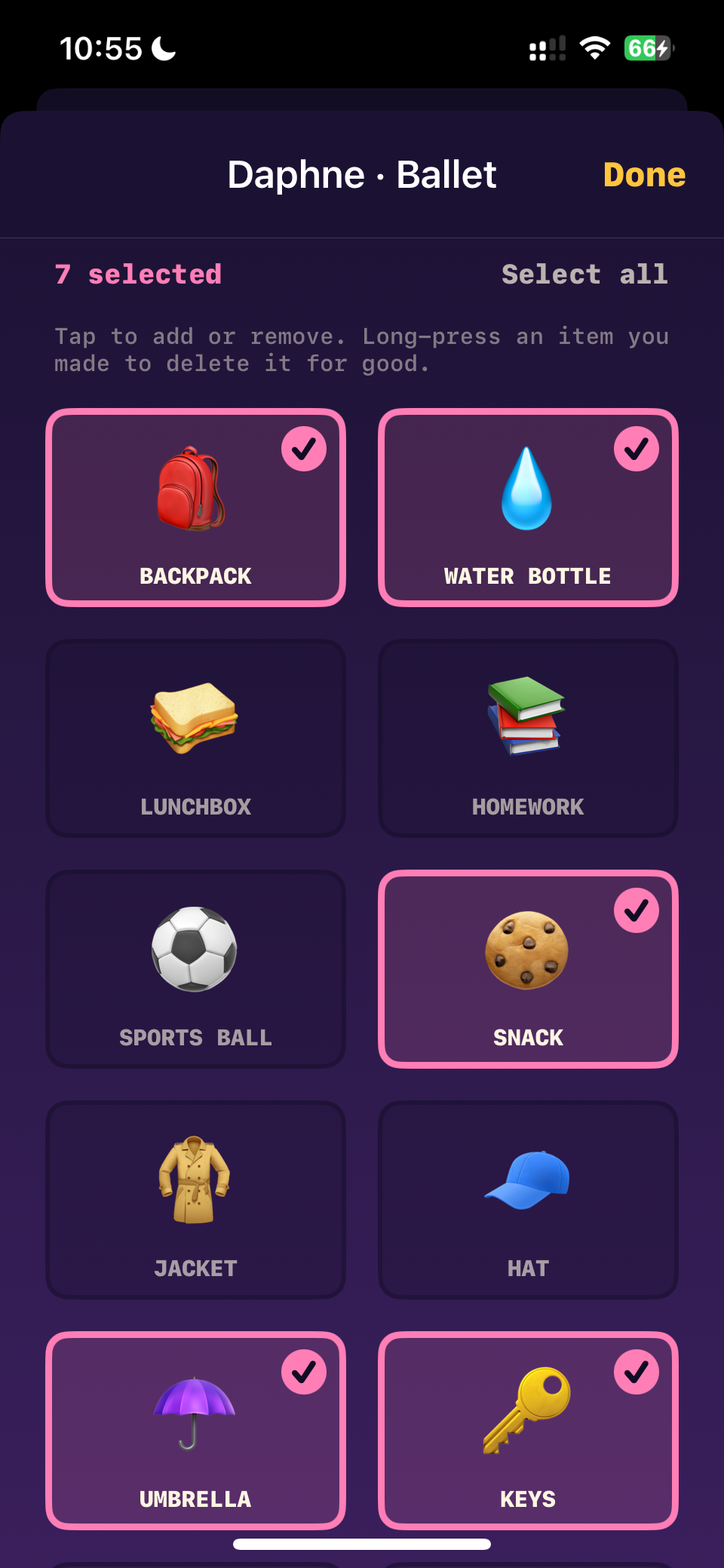
Ready Set Remember is an iPhone app I built for my own family after the paper version worked. It puts the list where the packing happens: each child has their own pixel avatar and their own routines, one per activity, so today's list contains only today's items and there's nothing to filter. Each item is its own large tile with its own picture, which is the part that matters for the seeing problem — the child is matching an image rather than searching a category. They tap each one as they find it, earn stars for finishing, and spend those stars in a rewards shop a grown-up sets up.
The narrow scope is deliberate. It does get-ready-and-go routines and nothing else. A $5 phone holder by the door and this is the whole setup.
- One routine per activity, per child — no master list to filter
- Big tap-to-pack tiles with sound and haptics
- Stars on completion, spent in a rewards shop you configure
- Pixel avatars kids build themselves
- Optional Apple Calendar link, so the right list appears on the right day
- iPhone, iOS 16 or later
Which fix should I try first?
| What it looks like at your house | Start here |
|---|---|
| They wander off mid-task and you find them playing | One item at a time, named and located |
| They look right at it and say "where?" | A pictured list at the point of packing |
| Mornings are frantic but nothing is actually missing | Stage bags the night before |
| You repeat yourself from another room | Go stand in the room; say it once |
| You're the one who finds every object | Point at the list, not the item |
| Different gear on different days | A separate routine per activity |
| They've stopped seeing the wall chart | Move it to eye level, cut it to six items |
Frequently asked questions
Why does my kid forget what I asked before they get down the hall?
A spoken instruction has to be held in working memory for the whole walk, with nothing anchoring it. In young children that's a few seconds of reliable storage, and any interruption on the way clears it. A list they can look at when they arrive removes the need to carry it at all.
Why does my child ask me where everything is when it's right there?
Because they're searching for a category rather than looking for an object. Saying the colour and the location turns it back into a visual match, which is a task they can actually complete.
Does yelling or hurrying ever make them faster?
Not in a way that lasts. It narrows their attention when the task needs broad scanning, and it gives them your mood to manage on top of the packing. A stated leave time or a visible timer does the same job without the cost.
Why is my kid fine some mornings and hopeless on others?
Sleep, hunger and how much of the plan changed overnight. Executive function is the first thing to degrade when a child is tired, and an unexpected activity means today's list has to be rebuilt from scratch instead of recalled.
We tried a chart and they stopped noticing it. What now?
Charts go invisible when they're static, in the wrong room, or too long. Move it to where the packing physically happens, cut it to about six items, and make today's list differ from yesterday's so there's a reason to look.
At what age should a kid be able to get ready without help?
Around six or seven for a short, visible, single-activity list, and later than most parents expect for anything open-ended. Being able to do it once is not the same as doing it reliably under time pressure.
Does screen time in the morning make this worse?
Measurably, yes — not because screens are uniquely harmful, but because disengaging from an absorbing task is itself an executive-function cost, and you're spending that budget before the packing starts.
Ready Set Remember is on the App Store, for iPhone. Questions or ideas: info@readysetremember.com.
Download on the App Store